 Ask me anything!
Most misunderstandings about Copenhagen Atomics happen before we even talk about reactors.
They happen at the level of language.
Terms such as SMR, Gen IV, advanced reactor, thorium reactor, or waste-burning reactor are used constantly in media, policy discussions, and investment decks — yet they often lump together technologies that are fundamentally different in physics, economics, fuel use, and build reality.
The purpose of this article is to examine those categories.
Not to argue semantics for their own sake, but because misleading labels create misleading expectations, which in turn lead to poor decisions about energy policy, capital allocation, and deployment timelines.
Copenhagen Atomics does not fit comfortably into existing labels. That is not a marketing claim; it is a structural fact.
1. The problem with nuclear labels
“SMR” no longer means anything useful
There is no agreed definition of Small Modular Reactor.
In mainstream usage, SMR most often refers to reactors such as Rolls-Royce SMR, GE Hitachi BWRX-300, and similar solid-fuel light-water designs. These reactors typically have thermal outputs on the order of 900-1400 MWth, require enormous amounts of concrete and steel, have multi-year construction timelines (comparable to AP1000 reactors), and require close to 100 tons of initial enriched fuel.
This is not what most people intuitively understand as “small”.
At this point, SMR has become a storytelling label, not a technical one. It is applied equally to reactors with the same price and build time as AP1000 sized plants and to so-called micro-reactors producing only a few megawatts.
When a single term covers systems with radically different fuel masses, construction complexity, refueling requirements, and cost structures, it no longer enables meaningful conversation.
For this reason, Copenhagen Atomics does not use the term SMR.
“Gen IV” is also not a meaningful category for us
Generation IV reactors are often presented as a fundamentally new class. This “classification” is misleading as it indicates that these reactors are somewhat similar. Nevertheless, Gen IV designs share two crucial features: they are all reactors requiring repeated refueling with fissile fuel and they are different from traditional light water reactors.
Regardless of coolant choice, neutron spectrum, or geometry, Gen IV concepts rely on repeated refueling with fissile material. None can demonstrate a credible path to long-term operation while being refueled only with fertile material such as thorium or depleted uranium.
This matters because the fuel cycle largely determines fuel cost over decades, fuel logistics and geopolitics, waste characteristics, and ultimately system scalability.
Copenhagen Atomics reactors are fundamentally different in this respect. Calling CA reactors Gen IV would be misleading — not because Gen IV is “bad”, but because it hides the most important distinction.
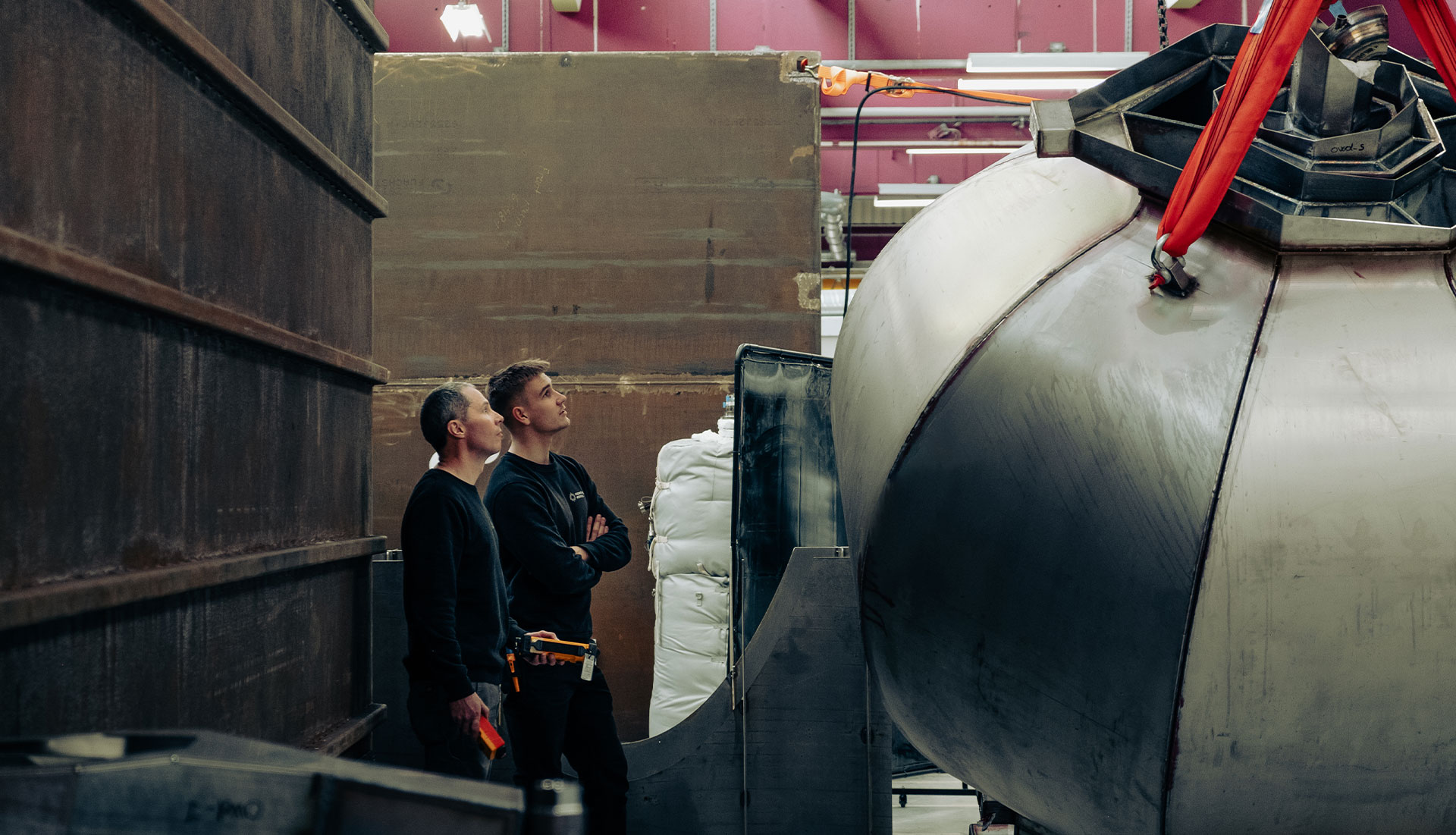
Copenhagen Atomics’ Onion Core™ on its way to be installed into a new full-size reactor prototype.
2. What actually makes Copenhagen Atomics different
The key distinction is the fuel logic
Most reactors in the world today — including advanced designs — are fissile-refueled systems. They load fuel, operate for some time, unload spent fuel, and repeat this cycle indefinitely.
Copenhagen Atomics reactors do not work this way.
A Copenhagen Atomics reactor uses a molten-salt system, keeps the same fuel salt in the reactor for decades, and continuously breeds new fissile fuel from fertile material in a separate blanket. Small quantities of thorium is added every 10 years to the blanket salt. While the reactor operates, this fertile material is converted into fissile fuel and fed continuously into the fuel salt.
While all other reactors only create energy from ~1% of the mined materials, CA reactors can use 99% of the mined materials.
This single difference changes everything downstream.
Why existing labels fail to capture this
Over the years, many labels have been tried — thorium reactor, breeder reactor, Gen V, advanced MSR. All of them create confusion.
Many reactors labeled “thorium reactors” still derive most of their energy from enriched uranium. The term breeder reactor is widely misunderstood as meaning “produces plutonium”, which technically applies to every reactor ever built. Generational labels (Gen 1, 2, 3, 4, 5, 6) have become so blurred that even experienced nuclear engineers often disagree on what belongs where.
Because of this, Copenhagen Atomics avoids these terms as primary descriptors.
What matters is not the label, but the constraint:
Copenhagen Atomics reactors are designed to operate long-term while being refueled only with fertile material.
That places CA reactors in a completely new category. Fertile fueled reactors.
3. Molten salt reactor — a broad category, not a definition
Copenhagen Atomics reactors are molten salt reactors (MSRs). We will continue to use that term — but with care.
MSR is a very broad category, much broader than LWR or PWR. It includes systems that differ in fuel type, salt chemistry, neutron spectrum, and fuel-handling strategy.
Simply calling something an MSR does not tell you how often it must be refueled, how much fissile material it requires, how waste is handled, or what the long-term fuel cost looks like.
Those distinctions matter far more than the headline label.
4. What “waste” actually means — and why CA is different
Every reactor ever built has had to reload fuel repeatedly. The unloaded material is called spent nuclear fuel (SNF), sometimes misleadingly referred to as waste.
Today, France is the only country recycling SNF at scale. Roughly nine tons of SNF are required to produce one ton of MOX fuel, which is widely believed to be more expensive than fresh enriched uranium. The remaining material is largely unused.
Many advanced reactor companies claim they can do better, but few publish numbers. Even when efficiency improves, the underlying logic remains the same: unload fuel, process it, fabricate new fuel, reload.
Copenhagen Atomics does not follow this cycle.
Because CA reactors never unload the fuel salt from the Cocoon and continuously transmute material inside the reactor, they can keep burning transuranics until they nearly disappear. When transuranics from SNF are combined with thorium in a CA reactor, it becomes possible to extract roughly ten times more energy from the SNF than in the reactor where it was first used.
This is a game changer for the nuclear industry as we know it today.
The strongest proof: incentives
Transuranics constitutes approximately 1% of SNF and in France they convert the best part of transuranics into MOX fuel.
Copenhagen Atomics is willing to buy transuranics at approximately 10,000 USD per kilogram.
For comparison, 5% enriched U-235 cost around 4,000 USD per kilogram at the end of 2025.
Every other company proposing to “burn waste” expects to be paid to take the waste.
This difference alone tells you more about the system than any marketing term.
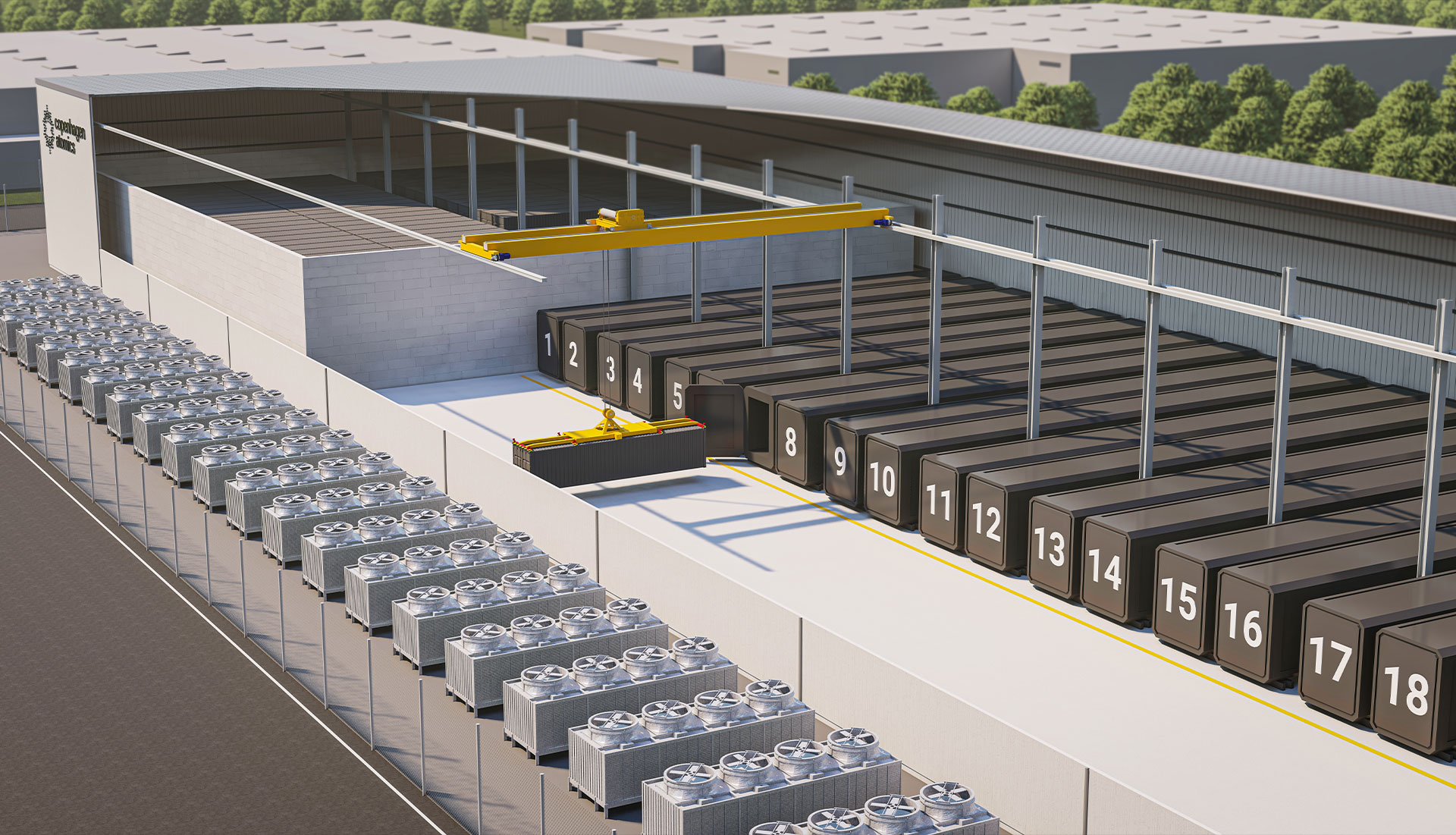
Partial view of a conceptual rendering of a Copenhagen Atomics 1 GW power plant.
5. A different distribution model
Copenhagen Atomics does not aim to become a traditional nuclear plant owner.
A better analogy is the industrial supply chain: Intel does not build data centers, Airbus does not operate airlines, and pump manufacturers do not own power plants.
CA reactors will be manufactured in CA-owned factories and supplied to many independent power-plant developers. These developers own the site, build the balance of plant, secure permits and financing, and operate the facility.
Copenhagen Atomics supplies the reactor and the fuel, retains ownership of the fuel, takes it back at end of life, and remains responsible for reactor capacity factor.
This alignment is deliberate. Because CA’s business model guarantees capacity factor, we are directly incentivized to maximize uptime and high return on investment for the plant owner.
The Copenhagen Atomics business model is like the “Intel Inside” slogan. CA only provide the reactor units which enable a power plant to reach hitherto unimaginable low energy prices. Just like Intel do not build labtop computers, servers or data centers. CA do not build power plants and engage with electricity customers.
6. Deployment reality
In most countries, it takes around ten+ years from initial planning to an operating nuclear power plant, including site selection, financing, licensing, and construction of buildings and infrastructure.
Copenhagen Atomics does not attempt to shortcut this reality.
What we change is what happens inside the plant — and the fuel logic that governs it.
Two years before delivery, the developer pays a $50 million down payment per reactor unit, allowing CA to start reactor and fuel production. Until that point, CA does not receive payments, except for optional consultancy support.
7. Free from government control
Most nuclear reactor developers are partly state owned or state sponsored and plan to build the first reactors in their home country.
Copenhagen Atomics originates in Denmark — a country without nuclear power plants and without government sponsorship of our work.
Our goal has never been to build reactors “at home first”.
From day one we were different. We always target the entire global energy market. We expect roughly:
- ~10 % of reactors to be deployed in the EU,
- ~20 % in the USA,
- And the majority in regions with rapidly growing energy demand.
Making this technology broadly available requires clear definitions, honest communication, and technologies that scale economically — not rhetorically.
Because CA reactors are inherently designed to be 100% load followers, there is no need for any humans to “control the reactor” in the control room. The only option is to shutdown. This greatly reduces training and costs related to “human factors”. Other micro-reactors also have similar features.
8. Getting started
If you are interested in building a power plant with “Copenhagen Atomics reactors inside”, the first step is simple:
- Sign an NDA
- Review the introductory document package
- Start an initial technical and commercial discussion
If mutual understanding is reached, we proceed toward a Memorandum of Understanding and site licensing details and additional documentation.